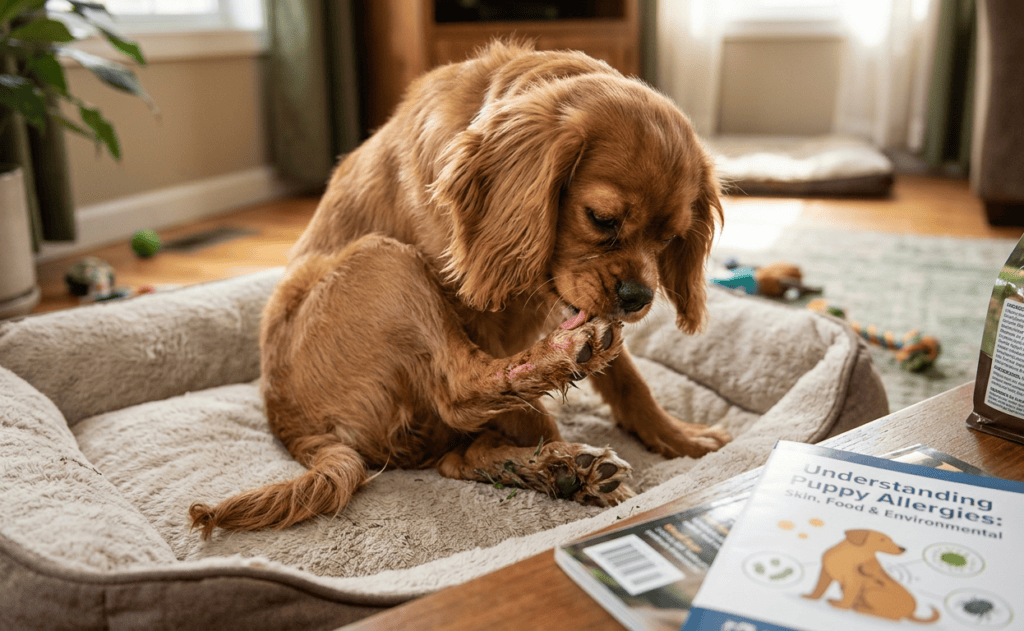
It’s more common than you think — and most of the time, it’s completely manageable once you know what to look for.You notice it at first while your puppy is resting — a quiet, rhythmic gnawing. Then it starts happening more often. Before long you’re Googling “why is my puppy keep biting their paws” at 11pm, wondering if something is seriously wrong. Sound familiar?
Here’s the honest truth: paw biting in puppies is one of the most common concerns new dog owners bring to vets. It can mean many things — some completely harmless, some worth keeping an eye on, and occasionally something that needs professional attention. The goal of this guide is to help you tell the difference, calmly and clearly.
What you’ll learn in this article
- The 5 main reasons puppies bite their paws (and tails)
- How to tell normal behavior from a medical symptom
- What to check at home before calling your vet
- When paw biting is a real red flag that needs attention
- Simple steps to help your puppy feel more comfortable
First things first: is this actually a problem?
Not always. Puppies explore the world with their mouths, and that includes their own bodies. Occasional paw licking and chewing — especially after a walk, after eating, or during a yawn-and-stretch — is completely normal grooming behavior. If it happens briefly and your puppy seems otherwise happy, calm, and unbothered, there’s a good chance nothing is wrong.
What you’re watching for is frequency, intensity, and location. Is your puppy doing this for extended periods? Are the paws looking red, swollen, or raw? Are they biting the same spot repeatedly, or chewing at their tail and back legs too? Those details matter — and they’re exactly what a vet will ask you about.
The 5 most common reasons why puppy keep biting their paws
🌿
Allergies
Environmental or food-related — paws are often the first place irritation shows up
🐞
Parasites
Fleas, mites, or mange can cause intense localized itching
🧠
Boredom or anxiety
Repetitive behaviors often develop when a puppy is under-stimulated
🦷
Teething
Chewing anything — including themselves — relieves gum discomfort
🩺
Injury or infection
A thorn, cut, or developing infection can make one paw especially painful
1. Allergies — the most overlooked culprit
Allergies in dogs don’t usually look like sneezing. They tend to show up as skin irritation — and the paws, being in direct contact with grass, pollen, cleaning products, and more, are particularly vulnerable. Your puppy may be reacting to something in their environment (seasonal allergens, lawn treatments, household cleaners) or something in their diet (certain proteins or grains).
A useful clue: if the biting gets worse during certain seasons or after walking in a specific area, environmental allergies are likely. If it’s consistent regardless of season or location, a food allergy is more worth investigating.
What to note for your vet When did it start? Did anything change around that time — new food, new cleaning products, a move, a seasonal shift? That timeline is genuinely valuable diagnostic information.
2. Parasites — small but worth checking
Fleas, mange mites (including the notoriously itchy sarcoptic mange), and other external parasites can cause intense, localized discomfort. The biting and scratching is the puppy’s attempt to relieve it. Mange in particular tends to cause hair loss, crusty skin, and distress that goes well beyond casual grooming.
This is one reason regular preventive parasite treatment matters, especially for young puppies whose immune systems are still developing. If you’re seeing skin changes alongside the biting, a vet visit is the right move.
3. Boredom, anxiety, and the behavioral side
Puppies need a surprising amount of mental and physical engagement. When they don’t get it, they find their own outlets — and repetitive chewing behaviors are a common one. This is especially true for intelligent, high-energy breeds. If the paw biting tends to happen when your puppy is alone, under-exercised, or in a stressful situation, behavior rather than a physical condition may be driving it.
Separation anxiety is a real and significant issue in young dogs. If paw biting accompanies other signs of distress — pacing, whining, destructive behavior — it’s worth speaking to your vet or a certified animal behaviorist about it directly.
4. Teething — temporary but uncomfortable
Between about 3 and 7 months of age, puppies go through teething. Their gums itch and ache, and they’ll chew almost anything to relieve the pressure — including their own paws and tail. If your puppy is in this age range, is also chewing furniture and shoes, and seems otherwise healthy, teething is probably a large part of the picture.
This tends to resolve on its own as the adult teeth come in fully. In the meantime, giving your puppy appropriate chew toys can redirect the behavior significantly.
5. Injury, irritation, or infection — check one paw at a time
If your puppy is focused on one specific paw rather than all four, look closely. A small thorn, piece of glass, cracked nail, or developing wound can be easy to miss but genuinely uncomfortable for your puppy. Left unchecked, minor wounds can become infected quickly — especially in warm weather.
Hot pavement can also burn paw pads in summer. It’s more common than people realize. If your puppy starts limping or biting after a walk on hot concrete, that surface temperature is worth considering.
Why do puppies bite their paws and tails together?
When biting extends to the tail, back legs, or hind end in general, the cause is often systemic rather than localized. Flea allergy dermatitis, for example, tends to concentrate around the base of the tail and hindquarters because that’s where fleas tend to congregate. Generalized anxiety can also express itself through roaming self-directed chewing.
The pattern tells a story. Localized biting of one paw = likely physical cause. Biting of all paws = more likely an allergy or systemic irritation. Biting paws and tail = worth a thorough parasite check and a vet conversation.
How to do a simple check at home
Before you call the vet, it helps to have some observations ready. Here’s what to look at:
1. Check each paw individually. Look between the toes, at the pads, and around the nails. Is there redness, swelling, discharge, or a foreign object? Is the skin discolored (rust or brown staining from saliva is common with chronic licking)?
2.Note which paw(s) are affected. One paw vs. all four is a meaningful distinction. One paw points toward a local issue. All four point toward something systemic.
3. Check for other symptoms. Is your puppy scratching elsewhere? Are there bald patches, skin changes, or signs of ear discomfort? Are their eyes or face itchy too? These patterns help narrow things down considerably.
4.Think about recent changes. New food, new walks, new household products, new season — environmental changes are often the key that unlocks the diagnosis.
5.Note the timing and frequency. Is this constant or occasional? After walks? At night? In specific rooms?
When should you actually call the vet?
Take these signs seriously
Persistent biting of one spot for several days in a row, visible wounds, sores, or raw skin, hair loss on or around the paws, lameness or reluctance to walk, secondary signs like face rubbing, ear scratching, or recurring skin infections, or any behavior that seems distressing rather than casual.
There’s no prize for waiting it out. If something feels off to you as an owner — even if you can’t quite articulate why — it’s always appropriate to call your vet and describe what you’re seeing. A brief phone consultation can often clarify whether an appointment is urgent or whether watchful waiting is reasonable.
New puppy owners often worry they’ll seem overcautious. You won’t. Vets would rather answer your questions early than treat a problem that’s had weeks to develop.
What you can do right now
If the biting is mild and your puppy seems otherwise well, a few things are worth trying while you monitor the situation. Keep the paws clean and dry after outdoor time — gently wiping them with a damp cloth removes surface allergens and irritants from walks. Make sure your puppy is on an up-to-date parasite prevention program appropriate for their age and weight. And ensure they’re getting enough physical activity and mental stimulation each day — both are more important than many first-time owners realize.
For puppies in the teething phase, providing appropriate chew toys and rotating them frequently can meaningfully reduce self-directed chewing. For anxious puppies, structured routines, calm environments, and — where needed — professional behavioral support make a real difference.
The bottom line
Paw biting in puppies is common, it has many possible causes, and most of them are completely manageable. The key is paying attention to the pattern — which paw, how often, under what circumstances, alongside what other symptoms — and not waiting too long if something seems genuinely wrong.
You’re not overthinking it by noticing. Attentive owners catch things early, and early is almost always better. Trust your instincts, gather your observations, and don’t hesitate to involve your vet when you’re unsure. That’s not being anxious — that’s being a good puppy parent.
